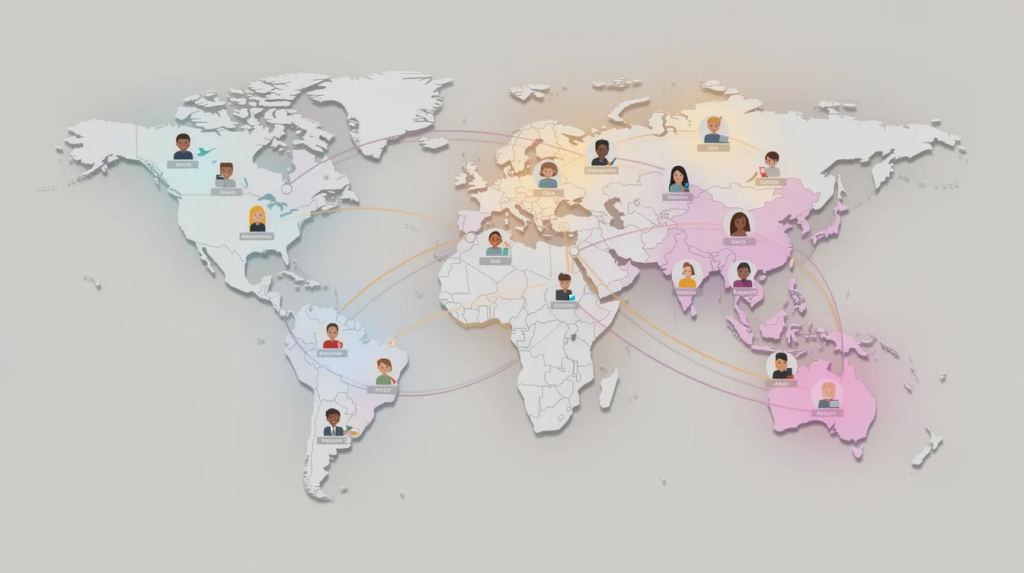
Nearshore Staffing in Latin America vs. Eastern Europe vs. Asia: Which Region Fits Your Team?
30–70%
Cost savings vs. U.S
2–3 wks
Typical time to hire
9+ Countries
in LATAM network
98%
Placement success rate
On this page
Choosing where to hire your next remote team member shouldn’t take weeks of research.
This guide breaks down the three major regions side by side so you can pick the right fit for your roles, budget, and working style.
The Short Answer: Which Region Fits Which Buyer, and Why
These three variables drive the decision: how sensitive you are to budget, how much you need live U.S.-hour collaboration, and whether you need niche technical expertise or broader operational talent pools.
The cheapest hire on paper is rarely the cheapest hire once you factor in management overhead and communication gaps.
The rest of this article will help you choose the best region, or combination of regions, for your next five to ten hires, not just your next role.
Side-by-Side Comparison: Latin America vs. Eastern Europe vs. Asia
The biggest real gaps between these regions aren’t just hourly rates. They’re time zone overlap and administrative complexity, the two factors that most directly affect how smoothly a new team member integrates into your daily workflows.
Use this table to compare all three regions across the criteria that matter most.
For most U.S. SMEs and startups, time zone overlap, collaboration quality, and administrative simplicity matter at least as much as chasing the absolute lowest rate. The table above shows where each region genuinely leads, and where it falls short.
What Each Region Actually Offers (Beyond the Stereotypes)
Below is an honest look at the strengths and limits of each region. None of these are strawmen.
Each has legitimate use cases, and understanding the trade-offs will keep you from making a hire you regret.
Latin America: Strengths and Real Limits
Latin America is usually the strongest nearshore staffing choice for U.S. companies that need their remote professionals working during U.S. business hours.
Cities like Bogotá (UTC-5), Mexico City (UTC-6), and Buenos Aires (UTC-3) sit within zero to three hours of most U.S. time zones, which means your nearshore teams can join morning standups, attend client demos, and respond to Slack messages in real time.
Latin America produces a growing number of bilingual professionals who are familiar with the tools U.S. teams use daily: Slack, HubSpot, Google Workspace, Salesforce, and Zendesk.
Countries like Mexico, Colombia, and Argentina are home to substantial technology ecosystems, and the region’s skilled talent pool is expanding rapidly across customer support, finance, RevOps, marketing, software development, and virtual assistant roles.
Short flight times from North America to Latin America also facilitate easy travel for quarterly planning sessions or team offsites.
The real limits are worth naming.
Rates are rising in hot markets like Mexico City, Costa Rica, and São Paulo, which shrinks the gap versus Eastern Europe for senior engineers.
English proficiency varies by candidate: Argentina scores in the “High” band on the EF English Proficiency Index at #26 globally, while Brazil sits lower, in the “Moderate” range.
Good nearshore staffing agencies pre-vet candidates to B2 to C1 English, but companies hiring on their own may encounter uneven communication quality. Certain deep technical niches, such as rare ML research profiles, may still have denser pools in Eastern Europe or India.
At Wow Remote Teams, we specialize in connecting U.S. companies with bilingual professionals across Latin America, handling sourcing, vetting, and payment coordination so your U.S. teams can plug into this talent quickly.
Eastern Europe: Strengths and Real Limits
Eastern Europe offers deep, specialized talent for complex engineering and product work.
Poland, Romania, and Ukraine have strong university-level STEM education systems and mature software outsourcing ecosystems.
For senior engineering roles in areas like distributed systems, DevOps, cybersecurity, and data infrastructure, the region’s bench of experienced professionals is genuinely deep.
If your priority is technical expertise over daily live overlap, Eastern Europe often delivers.
The limits are structural. A six-to-nine-hour time difference from U.S. time zones means your overlap window shrinks to two or three hours per day, usually in the U.S. morning.
West Coast teams get even less. Real time collaboration becomes limited to planned check-ins rather than fluid, all-day communication. Some countries also face geopolitical instability that can affect hiring continuity, a factor worth evaluating honestly when making long-term staffing decisions.
Eastern Europe is the right answer when a U.S. company needs senior, specialized engineers who can work mostly asynchronously via written specs and structured reviews, or when the company already serves European clients and benefits from a bridging time zone.
Asia: Strengths and Real Limits
Asia delivers the lowest headline rates among the three regions and has the largest talent pools by volume.
India, the Philippines, and emerging hubs like Vietnam offer well-established ecosystems for BPO, customer support, back-office processing, and IT services. Vendor-published cost indices, including the Remote Workforce Cost Index, put weekly rates for Manila and Pune well below U.S. domestic benchmarks, though as with any vendor’s own pricing data, treat the exact percentages as directional rather than independently audited.
The Philippines ranks #28 globally on the EF EPI with “High” English proficiency, and India has significant pockets of fluent business English, particularly in tech and BPO sectors.
The primary constraint is time. India and the Philippines sit 10 to 13 hours ahead of U.S. Eastern Time, yielding minimal natural overlap with U.S. business hours. Collaboration defaults to asynchronous workflows or requires team members to work overnight shifts, which can create retention and burnout issues if not managed carefully.
English fluency and communication style also vary widely across candidates, and some Asian business cultures lean toward indirect communication, which may require explicit management training for U.S.-style client expectations.
Asia is the correct call for overnight or 24/7 coverage models, budget-first execution work like data labeling or transactional support, and roles with standardized deliverables where daily live collaboration is not required.
Head-to-Head on the Criteria That Actually Matter
Five criteria drive outcomes more than brand names or marketing claims: nearshore cost, time zone overlap, English and communication quality, talent depth, and administrative load.
Here’s how the regions stack up on each.
Cost: Headline Rate vs. Real Total Cost
Asia often shows the lowest hourly rates on paper. A full-time virtual assistant in the Philippines can cost as little as $3 to $8 per hour.
Nearshore hires in Latin America often cost roughly what a junior U.S. hire would, with typical savings of 30 to 70% compared to U.S. salaries, according to Near’s 2026 State of LatAm Hiring Report.
But headline rate is not total cost.
When there’s little live overlap, management overhead climbs: decisions wait overnight, rework cycles stretch, and coordination eats into your internal teams’ productivity. Asia wins on pure rate.
Latin America often wins on total cost of ownership for roles requiring daily collaboration.
Time Zone Overlap and Real Time Collaboration
Latin America typically provides six to nine hours of daily overlap with U.S. Eastern Time, and four to six hours with Pacific.
Eastern Europe gives two to four hours with Eastern and almost nothing with Pacific afternoons.
Asia offers close to zero natural overlap without shift scheduling. Nearshore professionals working during U.S. business hours means nearshore teams avoid the overnight delays in communication that offshore arrangements often carry.
For any role where same-day feedback matters, Latin America wins clearly.
English Proficiency and Communication Quality
Individual candidate screening matters more than country-level averages. Good nearshore staffing companies vet candidates for both English proficiency and technical skills before presenting them to clients.
Many Eastern European and Latin American countries score “High” or “Very High” on EF EPI in urban tech hubs, while India and the Philippines have large populations with workable business English, especially in support and IT.
Cultural alignment tends to smooth integration of bilingual professionals into U.S. workflows.
LATAM and U.S. teams often share similar norms around directness, proactive communication, and client expectations.
For U.S.-style client communication, Latin America usually edges out.
For pure English-speaking population volume, Asia and Eastern Europe also perform well when candidates are properly vetted.
Talent Depth and Specialization by Function
Nearshore staffing fills roles across IT, customer support, and finance, among others. Eastern Europe and Asia have very deep pools for senior engineering and niche tech stacks.
Latin America is strong and rapidly growing, especially in web, mobile, cloud, and general software development roles, but thinner in some rare research specializations.
A fintech in New York hiring a React/Node team plus bilingual customer support specialists would lean toward Latin America.
A deep-learning infrastructure team might look first to Eastern Europe or India. There is no single winner: Eastern Europe often leads for niche senior engineering, Asia for large-scale BPO, and Latin America for blended teams of technical and non-technical staff working U.S. hours.
Administrative and Hiring Complexity for U.S. Companies
There are two basic paths: do-it-yourself, where you set up local contracts, handle taxes, and manage benefits individually, or use a staffing partner that handles vetting, local paperwork, and payment coordination.
Many providers across all three regions offer administrative and payment support of some kind, but the nearshore market in Latin America has a mature ecosystem built specifically for U.S. buyers.
Eastern Europe and Asia also have strong outsourcing firms, but U.S. SMBs may find more language and legal-structure friction when going direct without a partner.
With the right partner, Latin America is typically the simplest region for U.S. teams to plug into for nearshore staff augmentation and contract-based hiring.

When Latin America Is the Right Call
Latin America should be your default if your team works primarily on U.S. hours and talks to customers or internal stakeholders live each day.
A Series A to C B2B SaaS startup with 20 to 150 people needs SDRs, customer success managers, RevOps analysts, and a small engineering pod that can join 9 a.m. ET standups and client demos.
An accounting firm wants bilingual assistants, bookkeepers, and project coordinators who work 8 a.m. to 6 p.m. Central Time with clients.
A founder-led company is hiring their first remote executive assistant and marketing generalist, needing both significant cost savings and close day-to-day collaboration.
In all three scenarios, bilingual professionals can handle client calls and documentation while your team focuses on business growth.
Wow Remote Teams connects U.S. companies with pre-vetted bilingual professionals across Latin America, covering Staffing, Staff-to-Hire, and Direct Hire models.
When Eastern Europe Is the Right Call
Eastern Europe may be best when depth of engineering talent trumps live overlap.
Companies seeking highly specialized data engineers or AI platform builders who need senior engineers with experience in complex distributed systems can find top-tier talent here.
Collaboration happens mostly via planned check-ins and written specs rather than all-day Slack threads.
A U.S. company with existing European operations or clients benefits from a team working “between” U.S. and EU business hours.
A larger enterprise already using Eastern European dev shops can expand that proven track record without reinventing its operating model. For these use cases, the narrower overlap is a reasonable trade-off for talent density and technical expertise.
An accounting firm wants bilingual assistants, bookkeepers, and project coordinators who work 8 a.m. to 6 p.m. Central Time with clients.
A founder-led company is hiring their first remote executive assistant and marketing generalist, needing both significant cost savings and close day-to-day collaboration.
In all three scenarios, bilingual professionals can handle client calls and documentation while your team focuses on business growth.
When Asia Is the Right Call
Asia is ideal when overnight coverage or maximum budget stretch outweighs the need for live collaboration during U.S. business hours.
A U.S. SaaS company needing 24/7 customer support agents can use Latin America for U.S. day coverage and Asia for night, creating full global coverage. A data-heavy operation running large-scale data entry, QA, or tagging can be managed via queues and documented workflows at the lowest possible cost. A company with an established engineering leadership team can hand off specs to offshore teams in India or the Philippines and work via async tools.
These are strategic choices, not second-best ones, when aligned with the company’s operating model.
The Multi-Region Strategy: Blending Latin America, Eastern Europe, and Asia
Many mature global companies don’t pick just one region.
They use Latin America for roles requiring U.S.-day collaboration: sales, customer support, operations, and many engineering roles.
They add Eastern Europe for niche senior engineering where that region’s bench is deepest. They add Asia for overnight support or large-scale, budget-sensitive back-office work.
This approach provides 24/7 coverage without burning out a single team, balances cost and quality across different role types, and reduces risk by not concentrating all international hiring in one labor market.
The nearshore model doesn’t require you to choose one region forever.
Companies following a nearshore hiring process across regions often start with their highest-priority roles, usually those requiring daily live collaboration, and then layer in specialized talent or extended coverage from other markets as they scale.
Wow Remote Teams focuses specifically on nearshore staffing in Latin America.
Our role is to help U.S. companies design and execute the Latin America portion of a multi-region plan, working alongside your other providers for Eastern Europe or Asia rather than replacing them.
We handle the sourcing, vetting, onboarding, and payment coordination for the LATAM segment so your hiring managers and core team can focus on performance, not paperwork.
How Wow Remote Teams Fits into a Nearshore Staffing Strategy
Wow Remote Teams is a nearshore staffing partner serving U.S. businesses that want to hire nearshore talent from Latin America without managing the administrative complexity directly. We handle sourcing, bilingual vetting, staff augmentation, Staff-to-Hire, Direct Hire, onboarding, payments, and ongoing support.
We typically share a first shortlist of three to five pre-vetted candidates within three to seven business days of a confirmed role profile.
We fit best for companies wanting strong cost savings while keeping real time collaboration during U.S. hours. If you prefer a single partner to handle contracts, payments, and onboarding so that your hiring managers only focus on interviews and performance, that’s exactly where our nearshore staffing solutions sit.
Campaign execution, content production, analytics
Recurring bookkeeping, reporting, AP/AR at lower cost
Paralegal support, intake, document review
Transaction coordination, CRM management, lead follow-up
Customer support, listing management, fulfillment coordination
Admin support, billing, patient scheduling
QA, development, data engineering, technical support
Flexible capacity without U.S. payroll overhead
Revit, AutoCAD, drafting support
Data labeling, prompt engineering, workflow automation
Instructional design, LMS admin, student support
Reservations, guest communication, vendor coordination
How to Decide Your Region in 20 Minutes
You don’t need a three-month vendor evaluation to make this decision.
Here’s a simple framework any busy founder or ops leader can run through quickly.
Start by ranking your top three priorities: live collaboration during U.S. hours, cost savings, or access to niche specialized talent.
Then map each priority to the head-to-head verdicts above. If live collaboration ranks first, Latin America is your default.
If niche engineering depth ranks first, evaluate Eastern Europe. If budget floor ranks first and async is acceptable, Asia enters the picture.
Next, list the specific roles you plan to hire nearshore professionals for in the next 6 to 12 months.
Are they support, senior engineering, finance, marketing, or data engineering roles?
Pick a default region for the majority of those roles, usually Latin America for U.S. companies, and flag one or two roles that might warrant another region. Then talk to a specialist provider to validate your assumptions against current market data.
For the LATAM portion, start a conversation with Wow Remote Teams.
Bias toward starting small. Pilot one to three hires in your chosen region before committing to a 20-person team.
Nearshore hiring gives you the flexibility to scale up once you’ve confirmed the model works for your business.

Next Steps: Putting Nearshore Staffing to Work for Your Team
For most U.S. companies, nearshore staffing in Latin America is the default choice when your team needs live U.S.-hour collaboration, bilingual professionals, and meaningful cost savings across technical and non-technical roles.
Eastern Europe and Asia remain targeted options when deep specialization or 24/7 coverage takes priority over overlap, and the smartest companies blend regions rather than picking one exclusively.
If you’re ready to explore Latin America as your nearshore staffing partner region, talk to Wow Remote Teams about a pilot hire. We deliver pre-vetted bilingual candidates with transparent pricing, handle all onboarding and payroll, and get you from role brief to shortlist in 48 hours.
Start with one or two hires, see the nearshore solutions in action, and scale from there. Bookmark or share the comparison table above with your team as a decision-making reference for your next hiring conversation.
What To Know
Frequently asked questions
Is Latin America cheaper than Eastern Europe for nearshore staffing?
For many support, operations, and mid-level technical roles, Latin America is similar or cheaper on a loaded-cost basis, especially once time zone overlap and administrative overhead are factored in. Senior engineering roles in Eastern Europe can run $5,000–$9,500 per month compared to $3,500–$7,000 in LATAM, though the gap is narrowing in high-demand LATAM cities. The real savings often come from reduced management overhead when your nearshore teams work your same hours.
What is the time zone difference between the U.S. and Eastern Europe or Asia for remote teams?
Eastern Europe (UTC+1 to +3) is typically six to nine hours ahead of U.S. Eastern Time, giving roughly two to four hours of overlap. India (UTC+5:30) and the Philippines (UTC+8) are 10 to 13 hours ahead, yielding close to zero overlap without shift adjustments. Latin America (UTC-3 to UTC-6) offers six to nine hours of natural overlap with U.S. Eastern, making it the clear leader for live collaboration.
- Skills & Experience: Our assessment of technical skills entails practical challenges that test problem-solving abilities and a review of past successes to ensure proficiency in the relevant skills, technologies, and tools required.
- Cultural Compatibility: We understand and prioritize your cultural values to assess compatibility through personality assessments, ensuring seamless integration with your team.
- Language Proficiency: We test written and verbal communication English skills guaranteeing clear and collaborative interactions.
- Reference: We verify past performance and work ethic through background checks.
Can my company use more than one region at once?
Yes. Many companies use a multi-region strategy: Latin America for daytime U.S.-facing roles, Asia for overnight support coverage, and Eastern Europe for niche engineering. This provides 24/7 coverage, balances cost and quality, and reduces concentration risk across global markets.
Which region is best for non-technical roles like customer support, sales, or operations?
How much English proficiency should I expect from Latin American vs. Asian remote talent?
Strong English exists in all three regions but varies by candidate. According to Terminal’s 2026 salary insights, top talent across regions increasingly meets global communication standards. Good nearshore staffing firms pre-test spoken and written English to B2–C1 levels. Wow Remote Teams screens every candidate for english proficiency before presenting them, ensuring your skilled professionals meet your communication standards from day one.
Do I need a local entity to hire remote staff in these regions?
Most U.S. companies work through nearshore staffing companies or staffing partners that handle local contracts and payroll, so they don’t need to create their own entities. Wow Remote Teams provides this for Latin America, acting as the employer of record so you can hire nearshore professionals without building local infrastructure.
Ready to Hire Nearshore?
Start building your Latin American team today
Nearshore staffing rates start at $12/hour for entry-level roles. Companies save $35,000–$64,000 per hire annually. Get a shortlist of vetted candidates within 48 hours.
