

Global outsourcing contracts business processes across multiple countries, giving companies access to specialized skills, lower labor costs, and round-the-clock operations.
This guide covers the full landscape: offshore and nearshore models, service categories like BPO and KPO, real cost comparisons, data security risks, and how to choose the right partner for your team. Whether you run a startup or a mid-market firm, the information here will help you make informed decisions about where, how, and why to build international teams.
What Is Global Outsourcing?
In simple terms, global outsourcing means contracting business activities to external providers or remote professionals across multiple countries. A company might place customer support in the Philippines, software development in India, and finance jobs in Colombia.
The work gets done through cloud platforms like Slack, Zoom, and Teams; digital workflows facilitate remote team operations in customer support and IT services without requiring anyone to share an office space.
This is different from single-country offshoring, where a company sends one function to one distant country and calls it done. It is also broader than business process outsourcing alone, which typically covers transactional, repetitive tasks. Global outsourcing is an integrated strategy.
Functions with little need for physical presence are suitable for outsourcing, and most knowledge-work and support roles qualify.
The primary goals companies pursue:
- Cost savings: lower wages, reduced overhead, shared infrastructure
- Access to a wider talent pool: specialized skills (AI, cybersecurity, bilingual customer success) that may not exist locally
- 24/7 coverage: time zones spread across regions keep work moving around the clock
- Faster entry into international markets: local teams provide language, culture, and regulatory knowledge
How Global Outsourcing Works in Practice
Picture a mid-sized U.S. tech-enabled services company with 200 employees. Product development sits in India (12 engineers). Customer success runs from Colombia (8 bilingual reps). Accounting is handled by a team in Poland (3 analysts). Back-office data entry goes to the Philippines (5 clerks).
A vendor management office at HQ in Austin governs all four relationships. Cloud platforms enable asynchronous work for outsourced functions, while daily standups on Zoom keep everyone aligned.
Here is how global outsourcing works, step by step:
- Map business activities: separate core functions (product, sales) from support functions (IT, customer support, finance, human resources, administrative tasks). Decide what stays in house and what moves out.
- Choose locations: evaluate wages, language skills, infrastructure, and time zones. India for engineering scale; Latin America for bilingual customer-facing roles; Eastern Europe for fintech and security.
- Select engagement models: vendor-managed outsourcing, employer of record (EOR), independent contractor arrangements, or direct hire through a staffing partner.
- Establish service level agreements: define response times (e.g., support replies within 60 minutes), uptime targets, quality thresholds. Use service level agreements to clarify responsibilities between your company and each provider.
- Set up governance: a single cross-provider body tracks performance, compliance, risk, and culture. Define communication procedures for effective collaboration. Regular communication and strong management systems are essential for successful outsourcing.
- Design workflows: a “follow-the-sun” model moves tasks from Buenos Aires (afternoon) to Manila (overnight) to Warsaw (early morning U.S. time), creating near 24-hour coverage.
Documentation and standardized processes increase outsourcing success. Global outsourcing is effective for functions with measurable outputs, so tie every outsourced role to a metric. Maintaining tight communication between local teams and remote workers is critical; without it, handoffs break down.

Main Types of Global Outsourcing Models
Outsourcing models vary by geography (offshore, nearshore, onshore) and by service type (BPO, ITO, KPO). Most companies combine several. Choosing the right outsourcing model depends on the specific needs of the business: budget, collaboration intensity, talent requirements, and regulatory constraints. Here is a breakdown with concrete examples.
- Offshore outsourcing contracts services from distant countries with large time-zone gaps. A U.S. firm hiring 20 PHP developers in Vietnam or running a 50-seat call center in the Philippines is offshore outsourcing. The cost gap is the main draw.
- Nearshore outsourcing engages providers in geographically close countries. A U.S. SaaS startup hiring customer success reps in Colombia (same Eastern time zone) or accountants in Mexico (Central time) is nearshoring. The overlap in working hours makes daily collaboration practical. For a detailed comparison, see Nearshoring vs. Offshoring vs. Outsourcing.
- Onshore outsourcing uses third-party providers within the same country. A U.S. healthcare company outsourcing medical billing to a U.S.-based vendor to meet HIPAA requirements is an onshore model. Cost savings are smaller, but compliance is simpler.
- Business process outsourcing (BPO) manages specific business processes externally: payroll, accounts payable, virtual assistants, back-office data entry. Philippine BPO firms are the most common providers for voice-based support.
- Information technology outsourcing (ITO) hires external firms for IT functions: software development, QA, DevOps, cloud migration, cybersecurity. India and Eastern Europe dominate ITO.
- Knowledge process outsourcing (KPO) involves specialized professional knowledge tasks: financial modeling, legal research, data analytics, market research. KPO requires domain expertise, not just process execution.
A single company might run BPO in the Philippines, ITO in India and Poland, and KPO in Latin America, all under one governance framework.
Offshore Outsourcing: When Distance Makes Sense
Offshore outsourcing sends work to a distant country where labor costs are lower, and talent pools are deep. The time-zone gap typically exceeds four hours; for U.S.-India work, it can reach 10-12 hours.
Typical offshore destinations and their profiles:
- India: the largest IT-BPM industry globally. In 2025, India’s technology sector generated US$282.6 billion in revenue. Labor costs in India are lower than in the US, often by 50-65% for equivalent roles. Deep pools in software engineering, cloud, and data science.
- Philippines: The Philippines employed 1.9 million workers in the outsourcing sector in 2025. Strong English fluency, cultural affinity to U.S. customers, and dominance in voice-based customer support.
- Vietnam and Eastern Europe: growing for product engineering, QA, and fintech. Poland and Romania command higher rates than Asia but lower than U.S. or UK markets.
Benefits: aggressive cost reduction, massive candidate pools, ability to staff night shifts that map to U.S. daytime. Outsourcing is best for repetitive or specialized tasks like IT support and customer service.
Challenges: limited real-time collaboration, cultural distance (hierarchy norms, communication styles), stricter requirements for data security and compliance controls, and hidden costs from travel, rework, and management overhead.
Nearshore Outsourcing: Bridging Global and Local
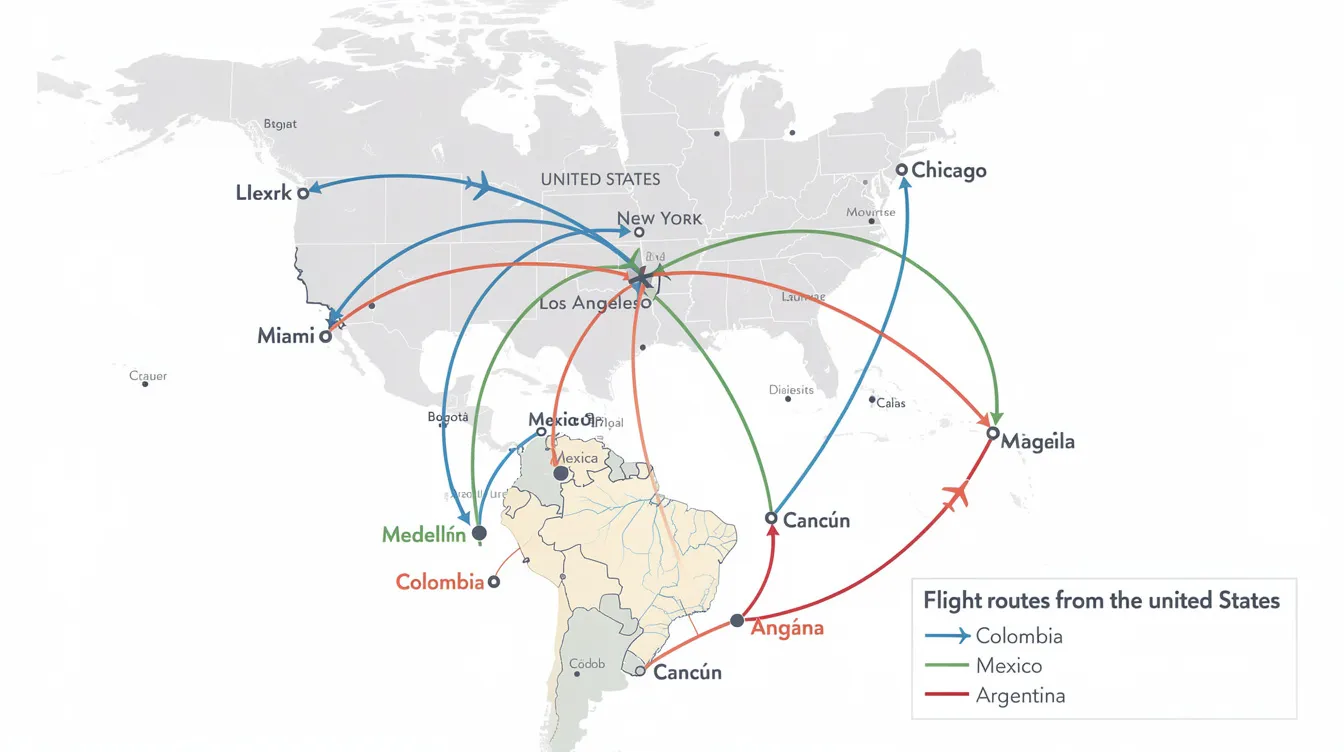
Nearshore outsourcing involves engaging service providers in nearby countries. For U.S. companies, that means Mexico, Colombia, Costa Rica, Argentina, and Panama. Nearshoring improves communication and collaboration due to geographical proximity; most Latin American countries sit within 0-2 hours of U.S. Eastern or Central time.
Key advantages:
- Time zone overlap increases efficiency in remote operations. A team in Bogotá shares U.S. Eastern time year-round (Colombia does not observe daylight saving time). Daily standups, Slack conversations, and real-time problem-solving happen without anyone staying up past midnight.
- Cultural affinity: many Latin American professionals grew up consuming U.S. media, understand American business norms, and hold bilingual (Spanish/English) fluency.
- Nearshore outsourcing allows for easier travel and scheduling between teams. A flight from Miami to Bogotá takes three hours.
- Nearshore outsourcing can reduce operational costs by 30-70% compared to U.S. fully loaded costs, depending on role and seniority.
Concrete example: a U.S. SaaS startup needs four bilingual customer success reps. It hires through a nearshore staffing partner in Colombia. Each rep costs $2,800-$3,500/month fully managed, versus $9,000-$12,000/month for a comparable U.S. hire. The team works the same hours, joins the same Slack channels, and handles escalations in real time. Companies can access bilingual professionals through nearshore outsourcing without sacrificing collaboration quality.
This model sits between offshore scale and onshore control. For roles requiring daily interaction, like customer-facing support, marketing, and finance, nearshore staffing is often the strongest fit.
Core Service Categories: BPO, ITO, and KPO Explained
Most outsourced work falls into three service categories. Non-core and back-office functions are often outsourced by SMEs, but larger companies use all three categories at scale.
Business process outsourcing (BPO) covers transactional, process-driven functions: payroll, accounting, HR admin, recruitment, virtual assistants, and back-office support. A U.S. e-commerce brand might outsource order processing and returns management to a Philippine BPO provider. Service delivery is measured by throughput, accuracy, and turnaround time.
Information technology outsourcing (ITO) covers software development, QA, DevOps, cybersecurity, cloud infrastructure, and help desk support. A mid-market retailer planning a 2026 cloud migration might assemble a mixed team: backend engineers in India handling AWS configuration, security specialists in Poland running penetration tests, and a project manager in Mexico coordinating timelines. ITO contracts often include uptime SLAs and defect-rate targets.
Knowledge process outsourcing (KPO) covers higher-value analytical and knowledge work: financial analysis, legal research, data science, data analytics, and market research. KPO roles require domain expertise. A U.S. fintech might hire financial analysts in Latin America or Eastern Europe for FP&A modeling, or a legal tech startup might outsource regulatory research to Indian lawyers.
A single company can run BPO in the Philippines, ITO in India, and KPO in Latin America, with governance centralized at headquarters.
Examples of Global Outsourcing Across Functions
Global outsourcing is not limited to technology. It spans most business activities across industries.
- Customer support: U.S. e-commerce brands outsource voice and chat support to the Philippines, where agents handle 24/7 coverage with strong English fluency. Bilingual professionals from Latin America can meet the needs of U.S. companies seeking talent for Spanish-English support.
- Software development: European fintechs recruit full-stack developers from India and Poland. Some combine backend engineering in India with UI/UX design in Latin America, using different countries for different skill sets.
- Finance and accounting: U.S. startups hire Latin American controllers, bookkeepers, and FP&A analysts through nearshore accounting and finance staffing partners. These roles require daily interaction with U.S. leadership, making time-zone alignment essential.
- Marketing and creative services: content writing, graphic design, and performance marketing outsourced to Mexico, Brazil, Colombia, Poland, and Romania, where bilingual or English-fluent talent handles campaigns for U.S. and European clients.
- Specialized KPO: legal process outsourcing in India, data annotation teams in Africa supporting AI model training, and analytics teams in Poland running market research for global consulting firms.
Global outsourcing helps fill skill gaps in various industries, from e-commerce to fintech to healthcare, wherever specific business processes can be executed remotely with measurable outputs.
Why Companies Choose Global Outsourcing
Motivations are both strategic and operational. For fast-growing startups and mid-market firms, the math is straightforward.
- Cost reduction is the top reason for outsourcing at 70%, according to industry surveys. Lower wages, reduced office space costs, and shared infrastructure add up. Outsourcing can save costs on office space and utilities alone by eliminating the need for local desks, equipment, and facilities.
- US companies outsource around 300,000 jobs annually. That figure reflects how deeply outsourcing is embedded in standard operations across sales, support, technology, and finance.
- Access to specialized talent pools can lower costs for companies that would otherwise pay premium rates to recruit scarce skills domestically. AI engineers, cybersecurity specialists, bilingual customer success managers, and specialized accountants are often easier to find in other countries.
- Outsourcing allows businesses to focus on core activities, enhancing efficiency. When your team stops handling payroll and routine support tickets, they spend more hours on product development, growth, and innovation.
- Outsourcing allows reallocating savings to other business operations. The money saved on a five-person support team ($200,000-$350,000 annually) can fund product features, marketing campaigns, or sales hires.
- Flexibility: global teams scale faster than domestic hiring. Adding 10 customer support reps in Colombia or 15 developers in India takes weeks through an outsourcing or EOR partner, versus months of domestic recruiting.
Benefits: Cost Savings, Talent, and International Markets
Beyond the headline numbers, the benefits of global outsourcing run deeper than base salary differences.
Cost savings beyond salary: recruitment fees in the U.S. often run 15-25% of first-year salary. In Latin America, staffing partners typically charge flat monthly rates. Benefits, real estate, equipment, and training costs are lower. Mid-level roles in Latin America cost $2,200-$7,500/month depending on seniority and country, compared to $9,000-$17,000/month fully loaded in the U.S. for comparable positions. Savings per hire can reach $35,000-$64,000 annually.
Talent diversity: outsourcing improves operational efficiency by accessing specialized expertise that may not exist in your local market. India produces hundreds of thousands of engineering graduates each year. The Philippines has deep experience in voice and written customer communication.
Latin America offers bilingual professionals across marketing, finance, and operations. Established outsourcing providers enhance turnaround times and service standards because they have refined their hiring, training, and management over years.
Entry into new markets: a support team in Mexico opens doors to Spanish-speaking customers across the Americas. A marketing specialist in Brazil understands Brazilian Portuguese and local consumer behavior. This local knowledge helps avoid misunderstandings when launching products or services in international markets.
Business continuity: teams spread across many countries provide redundancy. If a natural disaster or political disruption affects one region, operations continue in others. The global BPO market is projected to reach US$906.27 billion by 2035, reflecting how central outsourcing has become to global employment and operations strategy.

Key Risks and Challenges of Global Outsourcing
Global outsourcing delivers real advantages, but companies face challenges that require active management. Ignoring these risks leads to rework, lost money, and damaged client relationships.
Common risks:
- Communication barriers: language gaps, accent differences, and varying norms around directness or escalation can reduce clarity. Teams in different countries may interpret instructions differently.
- Cultural misalignment: expectations around deadlines, hierarchy, and feedback vary between regions. A team in India may not push back on unrealistic timelines the same way a U.S. team would.
- Data security risks: multiple jurisdictions mean varying data protection laws, IP exposure, and infrastructure reliability. Each outsourcing destination carries its own regulatory profile.
- Vendor dependence: if a provider’s quality drops or turnover spikes, your operations suffer. Concentration with one vendor creates a single point of failure.
- Uneven quality: some countries have deep senior talent; others offer mostly junior professionals. Overpromising by vendors is common.
- Time zone and coordination overhead: follow-ups, meetings outside regular hours, and delayed handoffs slow down complex projects.
Setting clear expectations is crucial for effective outsourced relationships. Measurable Key Performance Indicators help define outsourcing success, so every outsourced function should have agreed targets tied to business outcomes, not just activity metrics.
Data Security, Compliance, and Risk Management
Data security is now a primary selection criterion for outsourcing partners. A 2024 Deloitte survey found that data security concerns rank alongside cost savings as a top factor in vendor selection.
Typical security measures to require from any external provider:
- Encryption for data in transit and at rest
- Role-based access controls limiting who can see what
- Secure VPNs and managed devices for remote employees
- Audited physical facilities (for providers with offices)
- Background checks on all professionals handling sensitive data
Relevant regulations and standards include GDPR (EU), CCPA (California), SOC 2, and ISO 27001. Buyers should request proof of compliance before signing contracts. If your outsourcing destination is in Latin America, local compliance with country-specific labor and data laws also applies.
Contract-level protections matter as much as technical controls. Every agreement should include NDAs, data processing agreements, incident response clauses with defined notification windows, clear rules on data residency, and IP ownership provisions. When evaluating vendors, ask where data is stored physically, how cross-border transfers are handled, what disaster recovery plans exist, and whether employees receive regular security training. These questions separate serious providers from those who treat security measures as an afterthought.
Global Outsourcing vs. Building Direct Overseas Teams (EOR & PEO)
There is an important distinction between buying services from an outsourcing provider and directly managing overseas employees through an Employer of Record (EOR) or Professional Employer Organization (PEO).
In classic outsourcing, the vendor handles hiring, HR, quality management, and sometimes process ownership. Your company buys a service; the provider delivers it. You manage the relationship, not the people. Example: a U.S. company contracts a BPO in the Philippines for 30-seat customer support. The BPO recruits, trains, and manages the agents.
In an EOR model, the client manages daily work, goals, and culture. The EOR is the legal employer, handling payroll, benefits, tax withholding, and local compliance.
Example: a U.S. company hires three dedicated software engineers in Poland via an EOR. The engineers report to a U.S. engineering manager, join U.S. sprint ceremonies, and function as one team with the in-house staff. For more on how global talent acquisition works in practice, the distinction between these models is essential.
When each approach fits:
- Vendor outsourcing works well for transactional, project-driven, or high-volume work where you care about output, not individual employees.
- EOR/staffing fits when roles are long-term, strategic, and need deep integration with your company culture: dev, finance, operations, marketing.
Wow Remote Teams sits on the EOR/nearshore staffing side, connecting U.S. companies with dedicated professionals in Latin America while handling legal, payroll, and compliance overhead.
Global vs. Domestic Outsourcing
Domestic outsourcing means using third-party providers in the same country. A U.S. healthcare company outsourcing medical billing to a U.S.-based vendor avoids cross-border legal complexity, currency risk, and language barriers.
The tradeoff: cost savings are smaller. A U.S.-based virtual assistant costs $4,000-$5,500/month; a comparably skilled VA in Latin America costs $1,600-$2,500/month.
Global outsourcing offers labor arbitrage that domestic models cannot match. The salary differential between a mid-level accountant in the U.S. ($75,000-$95,000/year) and one in Colombia ($18,000-$30,000/year) is too large to ignore for cost-conscious businesses.
Diversification is another advantage. Spreading teams across different countries reduces exposure to any one economy’s political risk, regulatory changes, or currency fluctuations. If one region faces disruption, others keep operating.
Global teams also bring different perspectives, customer insights, and problem-solving approaches. A marketing team in Mexico understands Hispanic consumer behavior in ways a U.S.-only team may not.
That said, some regulated industries (healthcare, defense, certain financial services) may face compliance requirements that limit or prohibit cross-border data handling. For these, a hybrid model with domestic outsourcing for sensitive functions and global outsourcing for less-regulated support work is a practical compromise.
From Global Outsourcing to Global Staffing & Recruiting
Many companies start with vendor-based outsourcing: they buy a service, the provider delivers it, and the relationship is transactional. Over time, as a business hires more remote professionals, the need shifts. Companies want dedicated people who understand their product, join their meetings, and grow with the company. This is where global staffing and recruiting replaces traditional outsourcing.
Global staffing and recruiting works across India, the Philippines, Latin America, Eastern Europe, and Africa. The roles span marketing, finance, technology, operations, and support. Each region brings different strengths. India offers engineering depth.
The Philippines provides customer communication skills. Latin America delivers bilingual professionals with time-zone alignment. Eastern Europe supplies fintech and security expertise. Africa is emerging for data annotation and customer support.
Typical engagement models:
- Direct hire: the staffing partner finds, vets, and places a full-time employee in the target country. The business manages them directly.
- Staff augmentation: professionals join your team for a defined period or project, filling gaps without permanent headcount commitments.
- Staff-to-hire: a trial period (typically 3-6 months) before converting to permanent hire, reducing risk.
Employer-of-record partners and remote staffing agencies reduce legal, payroll, and HR complexity for multi-country hiring. They handle local compliance, tax withholding, benefits, and employment law, so your team focuses on managing the work, not the paperwork.
Nearshore Staffing in Latin America: A Strategic Variant of Global Outsourcing
Latin American nearshore staffing is a specific, high-value subset of global outsourcing. For U.S. companies, it combines the cost advantages of offshore with the collaboration quality of onshore.
Key benefits for U.S. companies:
- Cost savings of 45-70% compared to U.S. fully loaded costs, depending on role and country
- Same or similar time zones: Colombia (EST year-round), Mexico (CST), Argentina (EST +1 or +2)
- Cultural proximity: shared business norms, familiarity with U.S. products and media
- Growing bilingual talent base: Colombia, Mexico, and Argentina produce thousands of English-fluent professionals in tech, finance, and operations each year
Common nearshore roles U.S. clients fill through Latin American talent: virtual assistants, customer success managers, accounting and FP&A analysts, marketing specialists, project managers, and software engineers. These roles require consistent daily interaction, making time-zone alignment a practical requirement rather than a luxury.
Wow Remote Teams specializes in this nearshore model. The company acts as employer of record, handling sourcing, vetting, onboarding, payroll, and compliance so U.S. businesses can build Latin American teams without managing legal or administrative overhead. For companies already running offshore outsourcing in other regions, adding a nearshore layer in Latin America for high-collaboration roles creates a balanced global team.
How Wow Remote Teams Fits Into Your Global Outsourcing Strategy
Wow Remote Teams is a B2B remote staffing and recruiting agency that connects U.S. companies with pre-vetted, bilingual professionals across Latin America. The focus is on building trust through transparent pricing, fast hiring cycles, and ongoing support.
Service models:
- Nearshore staffing: dedicated remote employees placed on your team, managed by you, employed and supported by Wow Remote Teams
- Employer of record: legal employment, payroll, benefits, and local compliance handled for each hire
- Direct hire: permanent placement of Latin American professionals into your company
- Staff-to-hire: trial period before permanent conversion, reducing risk for both sides
Concrete benefits: hiring cycles measured in weeks (not months), flat monthly pricing with no hidden fees, overlapping time zones for real-time collaboration, bilingual (Spanish/English) professionals across marketing, finance, tech, operations, and support, and ongoing HR administration including payroll and compliance.
Example: a U.S. startup runs a 15-seat customer support team through a traditional offshore BPO in the Philippines. Response quality is acceptable, but the 12-hour time difference makes real-time escalation difficult, and the client’s U.S.-based customers sometimes struggle with accents.
The startup transitions five seats to a dedicated Latin American support team through Wow Remote Teams. The nearshore reps work U.S. Eastern hours, handle English and Spanish inquiries, and join the same Slack channels as the product team.
Annual savings per seat: approximately $40,000-$60,000 compared to U.S. hires. The client keeps the remaining Philippine seats for overnight coverage, creating one team that covers 20+ hours per day.
Best Practices for Implementing a Global Outsourcing & Staffing Strategy
For executives and founders designing or refining a global outsourcing roadmap, here are concrete steps.
Assess what to outsource: map your business functions. Separate core activities (product strategy, sales leadership) from support functions (customer support, accounting, HR admin, back-office operations). Functions with measurable outputs and standardized processes are the best candidates.
Choose target regions based on needs:
| Need | Strong regions |
|---|---|
| Engineering at scale | India, Eastern Europe |
| Customer support (English) | Philippines, Latin America |
| Bilingual customer success | Latin America |
| Finance and accounting | Latin America, India |
| Data annotation for AI | Africa, India |
| Fintech / security dev | Poland, Romania |
Start with a pilot: pilot projects help evaluate outsourcing providers before full commitment. Begin with 2-5 people or one function. Run the pilot for 90 days with clearly defined KPIs. Monitor service quality through customer satisfaction scores, turnaround times, and error rates. Regularly review provider performance against agreed targets before expanding.
Build communication and culture: shared onboarding, documentation, weekly rituals (team all-hands, retrospectives), and overlapping hours keep remote professionals connected. Use remote team management best practices to ensure consistency. Establish clear performance expectations in service agreements from day one.
Blend models: use vendor-based outsourcing for transactional work (data entry, basic support) and nearshore staffing for high-collaboration roles (customer success, finance, marketing). Partners like Wow Remote Teams handle the nearshore layer while your existing offshore vendors handle volume work.
Future Trends in Global Outsourcing and Remote Staffing
The global outsourcing market is projected to reach $906.27 billion by 2035. Several forces are reshaping how that money gets spent.
Hybrid automation + human models: AI and RPA are absorbing low-value repetitive tasks (data entry, basic ticket routing, invoice matching). The outsourced work that remains requires judgment, creativity, and emotional intelligence. This raises the bar for providers; the value shifts from cheap labor to skilled professionals who can work alongside automation.
Nearshore hubs are growing. Latin America and Eastern Europe are building deeper talent pools, better internet infrastructure, and more mature service delivery ecosystems.
According to the SSON/Auxis 2025 report, “access to talent or skills” has overtaken pure cost efficiency as the leading driver of outsourcing decisions for the first time since the pandemic. That shift favors nearshore models where collaboration quality is higher.
Regulatory and ESG pressure: data protection enforcement is intensifying globally. Companies are scrutinizing labor practices, environmental impact, and ethical sourcing in their outsourcing supply chains. Providers that cannot demonstrate compliance with GDPR, CCPA, and local employment law will lose contracts.
Emerging geographies: Africa is growing as an outsourcing destination for data annotation, customer support, and content moderation. As education systems and internet infrastructure improve across the continent, competition for outsourcing contracts will spread to more countries.
Companies that master global outsourcing and nearshore staffing now, combining offshore scale with nearshore collaboration and automation, will hire faster, spend less, and compete more effectively over the next decade. If you are ready to explore how to hire employees in Latin America, Wow Remote Teams can help you build a team that fits into your broader global strategy.


